Why Your CV Keeps Getting Rejected: Skills Employers Actually Want in 2026
You have sent dozens of applications. You check your email every morning. Nothing — not even a rejection, just silence. And now you do not know what to fix, because nobody tells you whether the problem is your CV format, your missing skills, or something else entirely.
Here is the useful reframe: most rejections are not personal judgements. They are filters. Your CV is being screened — often quickly, sometimes by software — for specific skills and proof, and generic applications fail those filters quietly. Fix the filters, and replies start coming.
Short answer: Most CV rejections happen before a human reads the CV properly — no matching skills, no proof of work, and generic one-size applications. The fix is twofold: rebuild the CV around role-specific skills with portfolio proof, and close the skills gap with a short practical course.
The 4 Real Reasons CVs Get Rejected
1. No role-specific skills
A CV that lists “hardworking, punctual, MS Office” for a marketing job, a design job and an office job tells the reader nothing about any of them. Employers screen for the skills of the specific role — social media and ads for marketing, design tools for design, spreadsheets and AI tools for office work. If those words and the ability behind them are absent, the CV is set aside regardless of your degree.
2. No proof or portfolio
Claims without evidence are cheap. “Good at graphic design” means little; a link to ten finished designs means everything. The same holds for marketing (a campaign sample), writing (published pieces), and web work (a live site). In a stack of similar CVs, the one with clickable proof is the one that gets a call.
3. One generic CV for every job
Sending the identical CV to thirty employers signals that you did not read any of the thirty job descriptions. Tailoring is not rewriting your life story each time — it is reordering your skills, rewriting your summary line, and leading with the experience that matches that particular role. Thirty tailored applications beat three hundred identical ones.
4. Missing digital basics
In 2026, basic digital fluency is assumed, not a bonus: comfortable use of common office and AI tools, presentable documents, professional email communication, and the ability to learn a new tool quickly. A CV that shows none of this — no digital skill, no online work, no tool names — reads as unprepared for a modern workplace, whatever the degree says.
The 2026 Skills List Employers Screen For
Qualitatively, these are the skills that appear across Pakistani job descriptions and freelance demand right now:
- AI tool proficiency — using chat assistants, AI content, image and office tools productively, with judgement. This is fast becoming the “MS Office” of the current decade: expected, not exceptional.
- Digital marketing — social media management, Meta ads, SEO basics. Every business needs customers online, so this skill is hired across industries, not just agencies.
- Design tools — Canva at minimum, Photoshop and Illustrator for design roles. Visual work is part of nearly every business’s daily output.
- Spreadsheets and data basics — clean sheets, formulas, presentable reports. Unremarkable, and quietly decisive in office hiring.
- Communication — clear written English and Urdu where relevant, professional emails, and the ability to explain work simply. This is screened in every interview, even when it is not listed in the ad.
Notice the pattern: these are practical, demonstrable skills, not subjects. Each one can be shown in a portfolio, which is precisely why employers screen for them.
Fix the CV in One Weekend
You do not need a designer or a paid CV service. One focused weekend is enough:
- Rebuild the skills section. Replace generic lines with specific, role-relevant skills: tool names, platforms, and what you can actually do with them.
- Add portfolio links. Create a simple portfolio — even a free page or a document with links — containing your best finished pieces, and put the link near the top of your CV. If you have no pieces yet, make three sample projects this weekend; sample work honestly labelled as sample work still counts as proof.
- Tailor per job. For each application, adjust the summary line and skill order to match the job description’s own words. Mirror the employer’s language, truthfully.
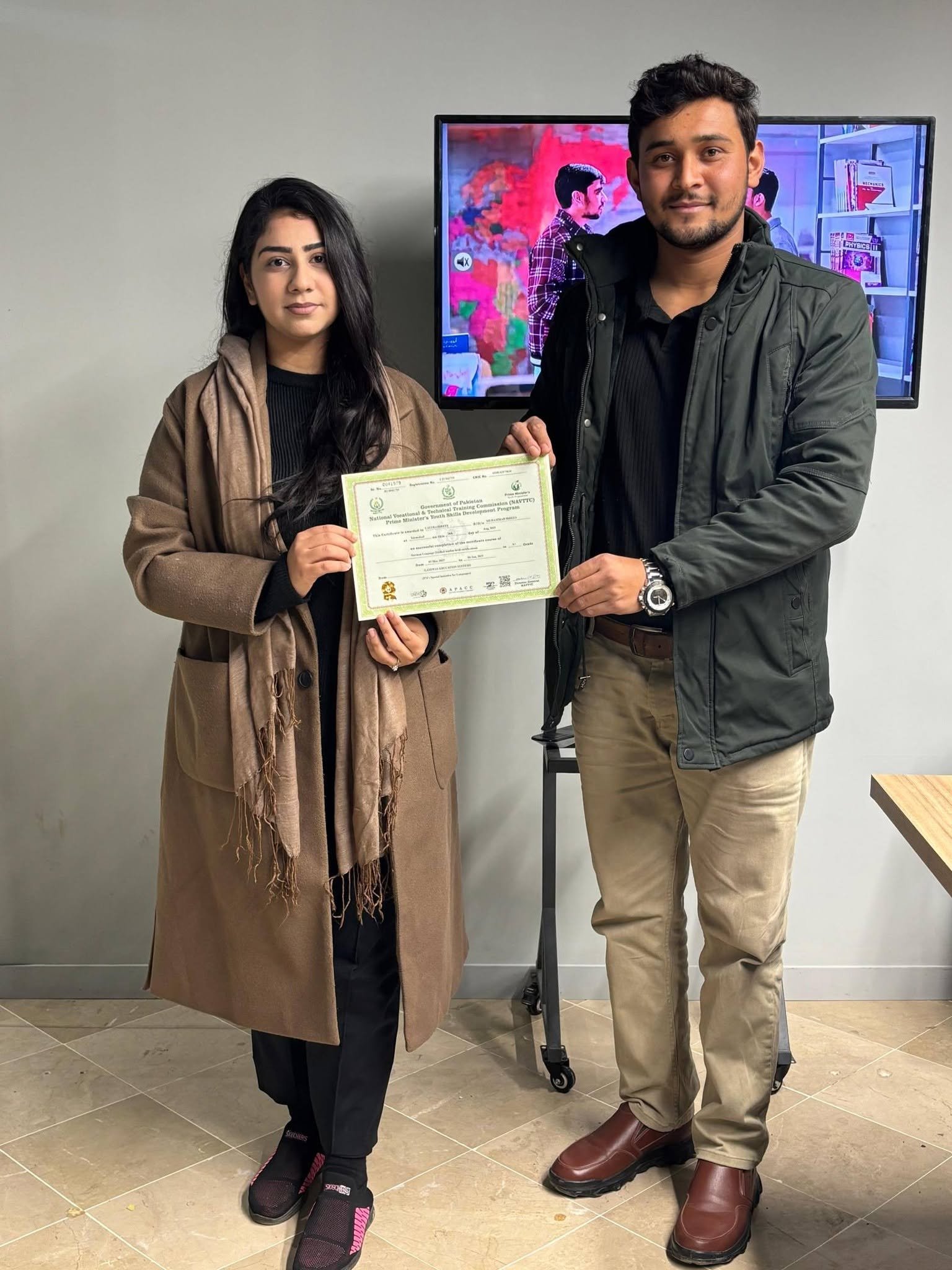
- Add verifiable certificates. Certificates that can be verified carry weight; certificates nobody can check carry little. Digitech certificates are verifiable, which is why they are worth listing with their verification details rather than as a bare course name.
Then apply again — to fewer jobs, better matched, with proof attached. Measure replies, not applications sent.
Fix the Skills Gap in 6–8 Weeks
If the weekend fix reveals that the skills themselves are missing, that is fixable in weeks, not years. Two routes cover most job seekers:
Route 1 — AI Tools (6 weeks, Rs 20,000). Best if you want the broadest employability upgrade: prompt engineering, AI content, image, video and office tools, automation, and a final project. Choose this if your target is office, marketing, teaching or content work and you want the skill employers now screen for first. That is the AI Tools Course in Rawalpindi.
Route 2 — Digital Marketing (8 weeks, Rs 25,000). Best if you want the most directly hired skill: social media, Meta ads, SEO and AI content, with campaigns you can show. Choose this if you want marketing, agency or business-facing roles, or freelance clients. That is the Digital Marketing Course in Rawalpindi.
Either route ends with projects and a verifiable certificate — the two things your CV was missing. See everything on the Courses page or ask on the Contact page. If you are a graduate wondering why the degree alone is not working, our companion guide explains the gap in full: Degree but No Job in Pakistan? Why Graduates Stay Unemployed — and the Skills Fix.
Proof Beats Paper
Degrees matter, and nobody here will tell you to hide yours. But in hiring, proof increasingly beats paper: a portfolio link, a verifiable certificate, a sample campaign, a small project done well. Employers hire what they can see working. Build one visible thing this month — a design set, a campaign sample, a simple website — and your next thirty applications will not look like your last thirty.
Not sure which skill to add first for your target jobs? WhatsApp 0311-3774804 — tell us the roles you are applying for, and we will suggest the single most useful skill to add, honestly and without pressure.
FAQs
Should I remove my degree from my CV?
No — add skills beside it. The degree shows education and perseverance; the skills show what you can do on Monday morning. Employers want both, and the CVs that get replies carry both.
Which single skill helps most?
For most job seekers in 2026, AI tool proficiency helps most broadly, because it applies to office, marketing, teaching and content roles alike. If you are targeting marketing specifically, digital marketing edges ahead. Tell us your target roles on WhatsApp 0311-3774804 for a specific answer.
Can certificates from short courses help?
Yes, when two conditions hold: the certificate is verifiable, and it is paired with projects that prove the skill. A certificate alone, like a degree alone, is a claim; a certificate plus a portfolio is evidence — and evidence is what gets replies.